 0000-0001-7733-0794
Education systems are increasingly expected to prepare learners to respond to complex, interconnected planetary crises. Yet many dominant approaches to what is commonly described as “climate literacy” remain narrowly focused on scientific knowledge, understanding atmospheric processes, weather patterns, and greenhouse gas emissions. While this knowledge remains necessary, it is not sufficient on its own to prepare learners to navigate planetary change and act responsibly in an interconnected world.
This reflects a broader challenge. In many education systems, dominant understandings of literacy remain largely oriented toward the acquisition of knowledge and information. While reading, writing, and scientific understanding remain essential, they do not in themselves prepare learners to navigate uncertainty, respond to systemic disruption, or act in just ways within complex socioecological systems (Kwauk, 2024). The challenge is therefore not to replace established forms of literacy, but to expand them in ways that enable individuals and communities to flourish under rapidly changing planetary conditions.
This narrowing is not simply a gap in curriculum content. It is reinforced when knowledge is divided across disciplines, learning is detached from lived contexts, and assessment privileges decontextualized individual performance. These arrangements make it difficult for learners to trace relationships among ecological change, political and economic decisions, unequal exposure to harm, and possibilities for collective response. They can also constrain educators who need time, professional autonomy, institutional support, and sustained relationships with communities to work across disciplinary and institutional boundaries. Advancing socioecological literacy therefore requires changes not only in what is taught, but also in how learning is organized, supported, and connected with the world beyond educational institutions.
Global evidence reinforces the need for this broader understanding of literacy. UNESCO’s review of education policies and curricula across 46 Member States found that more than half made no reference to climate change and only 19 percent mentioned biodiversity; where environmental issues appeared, they were often treated cursorily (UNESCO, 2021). At the same time, UNESCO’s Greening Curriculum Guidance signals growing recognition of a more holistic approach, calling for climate learning to bring cognitive, social-emotional, and action-oriented dimensions together across formal, non-formal, and informal settings (UNESCO, 2024). Together, this evidence and emerging policy direction point beyond simply adding planetary issues to curricula toward changing how learning about them is understood and organized.
Socioecological literacy is a situated and evolving practice through which people and communities orient themselves within living systems: perceiving relationships, discerning responsibilities, navigating uncertainty, and acting in ways that sustain collective wellbeing across time and scale. It draws on ecological literacy’s invitation to learn to read the living world—not as a backdrop to human activity, but as the web of relationships through which life becomes possible (Orr, 1992; Sterling, 2001; Capra & Luisi, 2014). The term socioecological makes explicit that these living relationships cannot be understood apart from the histories, institutions, economies, political arrangements, and unequal relations of power that shape them. It therefore concerns not only how ecological systems function, but also how benefits and harms are distributed, whose knowledge is recognized, how collective decisions are made, and what responsibilities arise from human participation within living systems. Used here, literacy is not intended to divide people into those who are “literate” and “illiterate,” nor to position experts as transmitting correct knowledge to others. Instead, it emphasizes learning as relational, participatory, and continually developing.
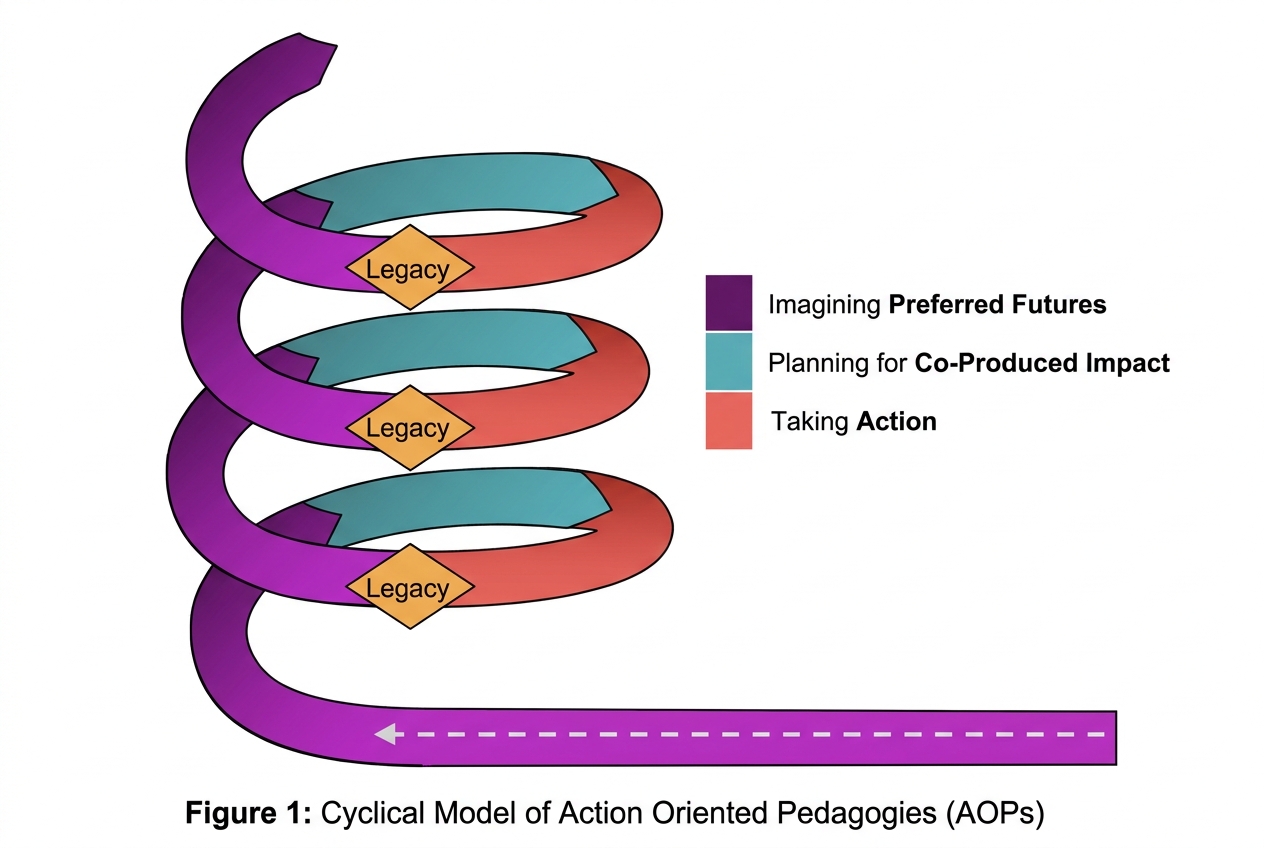
The need for socioecological literacy is both epistemic and practical. Climate change unfolds through interconnected challenges involving energy, food, migration, health, justice, and other dimensions of collective life. Responding requires people and communities to perceive relationships, interpret complex systems, exercise context-sensitive judgment, and engage with possible futures—not as outcomes to be engineered, but as possibilities to be imagined and negotiated collectively (Miller, 2018). Systems thinking, intersectional and futures-oriented inquiry, collaboration, and action are therefore mutually reinforcing dimensions of socioecological agency. Action-oriented pedagogies offer one way of bringing these dimensions together by engaging learners in consequential, community-connected work that links inquiry, collective action, and critical reflection (Thanapornsangsuth et al., 2025; Weinberg et al., 2024). Grounded in shared responsibility, they create supported and participatory spaces in which learners work alongside educators, communities, and relevant institutions to determine what action is warranted, deliberate across differences, connect local initiatives with wider structural conditions, and reflect on consequences, limitations, and changing circumstances. In this way, agency becomes relational and collective.
Learning, in this sense, is not abstract or decontextualized. It is embedded within socioecological systems—relational networks that include people, places, and more-than-human worlds shaped by interdependence, unequal histories, and continual change (Vossoughi et al., 2023; Westley et al., 2011). Because socioecological conditions differ across places and change over time, responsible action cannot be prescribed through universal solutions. Socioecological literacy develops through sustained attention to how relationships, risks, and responsibilities are configured in particular contexts—and how they change.
Socioecological literacy emerges across the full ecology of learning—lifelong, life-wide, and life-deep—extending beyond formal schooling into communities, workplaces, cultural traditions, and everyday life (Orlovic Lovren, 2022). Within this ecology, knowledge is distributed and situated, developing through participation, interaction, and shared inquiry. As Battiste (2002) argues, this requires a shift from a singular to a relational understanding of knowledge, where learning becomes a process of participation within interconnected, contested, and changing systems.
This reframes literacy itself. Socioecological literacy is not only cognitive but also ethical, political, and relational. It shapes how people and communities interpret change, understand responsibility, and act in just ways within shared systems. It concerns how people, communities, and institutions become answerable for their participation in those systems and mobilize knowledge, experience, ethical judgment, and collective action in support of ecological integrity, social justice, and intergenerational and interspecies wellbeing.
In doing so, socioecological literacy also reframes educational purpose: from preparing individuals primarily to adapt to existing systems toward supporting people and communities in questioning and reshaping the systems that affect their lives. Education becomes a site for interrogating the structural drivers of planetary crises, challenging extractive logics, imagining alternatives, and participating in collective responses. Learning thus becomes a practice of ethical participation and planetary action, grounded in relational responsibility and enacted through context-responsive, place-based, and community-rooted forms of education.