 0000-0002-4632-716X
The emotional landscape of the climate crisis offers a powerful window into how learners experience their relationships with communities, institutions, future generations, and the living world. Climate anxiety, grief, anger, fear, hope, and disconnection are increasingly documented, especially among children and youth, signaling not only environmental instability but a deeper rupture in the social and relational foundations that sustain human and planetary wellbeing (Hickman et al., 2021; Pihkala, 2020). These emotions can be further intensified by exposure to severe weather and other climate impacts, uncertainty about the future, and perceived institutional inaction, contributing to feelings of overwhelm and diminished agency (Hickman et al., 2021; Lewandowski et al., 2024). Without supportive relational environments, these pressures can contribute to distress that constrains learning, reduces engagement, and erodes trust in institutions. Importantly, these emotional responses should not be understood as signs of individual fragility. Rather, they are collective signals that something larger is unfolding—a lived experience of ecological disruption, social uncertainty, unequal exposure to harm, and institutional inadequacy.
Climate emotions can therefore serve as early indicators of strain across communities, institutions, and everyday life, revealing not only how individuals are coping with environmental change, but also how societies are struggling to sustain relationships of care, responsibility, and hope in an increasingly uncertain world. Far from being peripheral to learning, these emotional and relational dynamics shape how individuals and communities interpret risk, respond to disruption, imagine alternative futures, and participate in collective action.
A growing body of research suggests that learners’ emotions significantly influence how they engage with the climate crisis. Positive emotional experiences—including joy, curiosity, awe, hope, and belonging—can support engagement, nature connection, and critical and creative thinking, while disconnection and despair can contribute to withdrawal or disengagement (Neurohr et al., 2024; Ojala, 2012, 2016). These insights resonate with—but should not be equated with—many Indigenous, land-based, and Earth-based knowledge traditions, in which emotional, ethical, and spiritual ties to land are inseparable from responsibilities of reciprocity, reverence, and long-term stewardship. Such traditions challenge dominant educational assumptions by recognizing emotions not solely as individual psychological states, but as dimensions of relationship, responsibility, and ethical orientation. From this perspective, emotional learning can help sustain reciprocity, responsibility, and long-term relationships with the living world.
Yet even as emotional pressures rise across communities, many education systems remain anchored in cognitive and technical approaches that do not adequately address the conditions learners must navigate. This recognition has brought renewed attention to social and emotional learning (SEL), highlighting emotional, relational, and ethical learning as essential dimensions of education (UNESCO, 2024). SEL can support empathy, emotional regulation, responsible decision-making, and relational resilience—qualities that can help learners engage constructively with climate disruption and uncertainty rather than becoming overwhelmed or disengaged (Ojala, 2012; Neurohr et al., 2024). Emerging work in climate justice education further emphasizes that SEL must address more than individual coping, extending to solidarity, collective care, and structural inequity (Chaudhary & Iyengar, 2025). Its transformative potential is constrained when it is framed primarily as an agenda of individual competency and self-management. Climate emotions emerge from wider social, political, cultural, and ecological systems that shape how learners experience and make meaning of disruption. Educational responses must therefore cultivate individual and collective resilience alongside collective agency rooted in care, solidarity, democratic participation, and responsibility for social and ecological transformation.
Recognition of emotional and relational dimensions of learning is increasingly reflected in international policy frameworks. The UNESCO Recommendation on Education for Peace, Human Rights and Sustainable Development (2023) adopts a holistic understanding of learning that extends beyond cognitive achievement and emphasizes the development of empathy, compassion, solidarity, ethical responsibility, and an ethic of care. Among its guiding principles are cultivating "an ethic of care, compassion and solidarity" and protecting the "safety, health and well-being of learners and teachers" (UNESCO, 2023). These principles provide an important policy foundation for understanding emotional and relational learning not merely as a matter of individual development, but as a foundation of sustainable, peaceful, and just societies.
Emotional responses to the climate crisis are also shaped by how learners interpret what they are experiencing. Research in higher education suggests that distress and disengagement can be intensified by a disconnect between what people know and feel about planetary crises and how their institutions respond (Pigott et al., 2024). This disconnect can intensify feelings of uncertainty, isolation, and disbelief, especially when learners do not see their emotions acknowledged or validated in educational settings. Emotional meaning-making is not only an internal process but a relational one, shaped by family, culture, public discourse, and the trust learners have in societal institutions. These dynamics demonstrate why emotional literacy and relational support must be understood as foundational components of any educational response to the climate crisis. Evidence from a 63-country study further indicates that no single informational, emotional, or relational intervention produces consistent forms of climate engagement across audiences and outcomes. Its findings reinforce the need for approaches that are responsive to context, purpose, and the forms of action being supported (Vlasceanu et al., 2024).
As climate impacts intensify, emotional experiences are shaped by unequal burdens and histories of harm. Communities facing recurring or severe environmental risks—whether from disasters, pollution, or slow-onset degradation—may experience emotional pressures compounded by social inequality, historical injustice, and limited institutional support. Survey evidence indicates that climate distress varies across national and social contexts, is associated with perceived exposure to severe weather, and is often connected by young people to inadequate institutional responses (Hickman et al., 2021; Lewandowski et al., 2024). These patterns underscore the need for trauma-aware, context-responsive learning environments that acknowledge differing experiences of loss, risk, and injustice and help learners sustain connection and collective agency. Climate emotions therefore illuminate not only psychological stress but the uneven distribution of vulnerability, responsibility, and care across societies, making emotional inequity an important dimension of climate justice.
Recognizing the plurality and ethical complexity of climate emotions is essential. As Oberman (2024a, 2024b) argues, emotions evoked by ecological beauty, systemic injustice, or climate threat are distinct and carry different implications for learning, interpretation, and engagement. Climate education can create space for learners to differentiate and interpret these emotions—not to manage or suppress them, but to understand what they reveal about values, inequities, and responsibilities. This orientation also resonates with the relational, embodied, and ethical approaches explored in Insight 3, including Indigenous and land-based traditions that emphasize care, humility, and responsibility across generations while remaining grounded in distinct communities, places, and knowledge systems.
Within this emotional terrain, hope emerges not simply as optimism, but as a form of relational and collective agency. Research and practice on climate coping distinguish active or constructive hope—grounded in an honest recognition of present conditions, relational support, possible pathways for action, and a sense of collective possibility—from passive optimism or denial (Macy & Johnstone, 2012; Ojala, 2012). Hope can become especially generative when learners experience it collectively, as members of communities capable of imagining and creating alternative futures together.
Educational approaches grounded in storytelling, creative expression, contemplative practice, and collaborative futures thinking can help learners rehearse alternative pathways and build a shared sense of agency in the face of uncertainty. These practices can enter into dialogue with relational and land-based pedagogies that emphasize continuity, reciprocity, and long temporal arcs of planetary responsibility. Research further suggests that educational interventions inviting people to consider future generations can strengthen concern for their wellbeing and willingness to act on their behalf, reinforcing intergenerational responsibility as an important dimension of climate education (Syropoulos et al., 2025; Law et al., 2025).
The UNESCO MGIEP report Rethinking Learning: A Review of Social and Emotional Learning for Education Systems(2020) provides additional support for this perspective. Synthesizing evidence from education, neuroscience, psychology, and the learning sciences, the report associates social and emotional learning with empathy, cooperation, prosocial behaviour, and capacities for working collectively across differences. These emotional and relational dimensions of learning are increasingly recognized as important foundations for addressing complex sustainability challenges, including climate change, which require collaboration, ethical reflection, long-term thinking, and collective action across generations and communities.
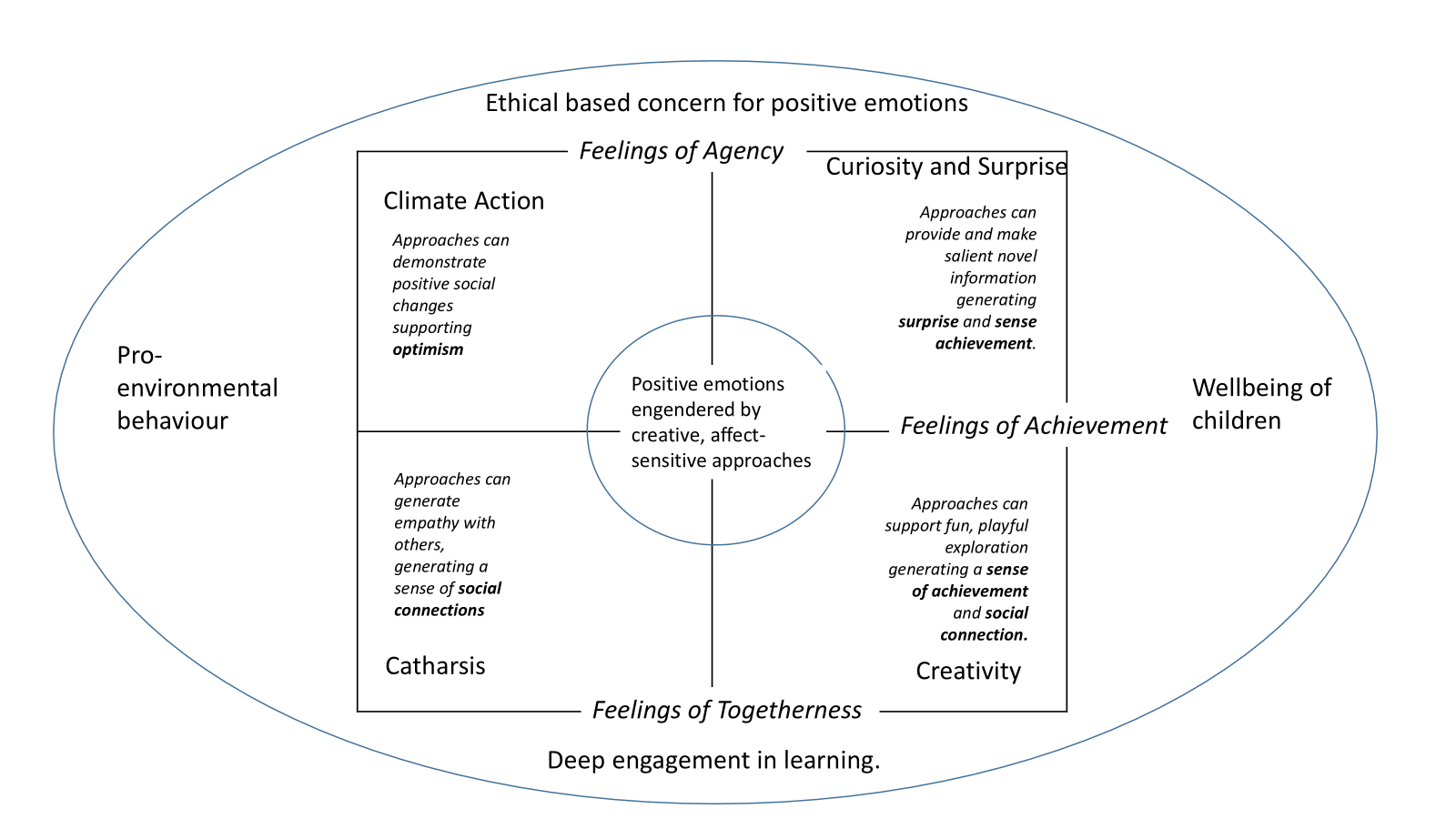
Positive emotions such as joy, fascination, and wonder can play an important sustaining role in climate education. Encounters with nature that evoke these emotions can offer learners a sense of vitality, connection, and belonging alongside the grief and fear often elicited by climate learning. Research associates experiences of awe, interest, beauty, compassion, and other positive emotions with nature connectedness, creative engagement, and prosocial or pro-environmental orientations (Lumber et al., 2017; Richardson et al., 2020; Oberman, 2024a; Piff et al., 2015; Neurohr et al., 2024). The broaden-and-build theory further suggests that positive emotions can expand attention and gradually build cognitive, psychological, and relational resources (Fredrickson, 2001). Far from trivial, joy can provide affective energy that helps sustain civic participation and regenerative action.
Together, this body of evidence points to the need for a shift in how education understands learning, agency, and transformation. Emotions are not secondary to cognition, nor are they merely personal responses to environmental change. They are relational forces that shape how individuals and communities interpret risk, sustain hope, build solidarity, and mobilize for change. As planetary pressures intensify, education must engage more fully with these emotional and relational dimensions of collective resilience, democratic participation, and societal transformation. The challenge for education is therefore not simply to help learners understand planetary crises, but to cultivate forms of learning that sustain connection—to themselves, to one another, to future generations, and to the living world. Emotional and relational learning is not a supplementary educational outcome; it is central to how societies respond to planetary crises and shape more just, regenerative, and life-sustaining futures.