Education for Planetary Futures: Learning with a Changing World

Modern education systems were largely shaped by a world of expanding economies, relatively stable institutions, and confidence in humanity’s capacity to plan and manage the future. Today, they face profoundly different conditions. As ecological systems destabilize, social inequalities deepen, democratic institutions fray, and inherited models of progress reach their limits, education confronts a defining question: what forms of learning and relationships are needed to sustain life and collective flourishing in the decades ahead?
Educational transformations rarely emerge fully formed or become visible all at once. They take shape through dispersed practices, shifting relationships, renewed attention to long-standing knowledge traditions, and new responses to changing conditions. Some remain difficult to recognize because they do not fit established disciplinary categories, policy frameworks, or systems of measurement. Others are well established and clearly articulated, yet remain marginal to mainstream policy and practice because institutional structures and dominant paradigms have been slow to change. Emergence, therefore, does not necessarily mean novelty. Ideas and practices gaining wider attention today may have deep intellectual, cultural, and political histories; what is emerging may instead be their wider recognition, new relationships among them, or their growing significance under changing conditions.
Key Insights on Education for Planetary Futures therefore looks across this wider landscape: not only to what is new, but to what is becoming newly visible, connected, or consequential—and to what has long been known or practiced yet remains peripheral to dominant educational agendas. In doing so, the initiative seeks to bring into focus transformations that established categories and agendas may overlook or resist. By reading across practices, ideas, knowledge traditions, and contexts, Key Insights attends to what becomes visible in relation—the connections, tensions, absences, and possibilities that can reshape how educational change is understood.
Key Insights responds to this challenge through an ongoing global process of collaborative inquiry and collective sensemaking. Bringing diverse disciplines, regions, sectors, and knowledge traditions into dialogue, the initiative looks across and beyond established educational agendas to trace patterns, tensions, and connections that no single perspective can reveal on its own. Rather than treating educational transformations as isolated developments, it examines how shifts in knowledge, human agency, institutions, governance, and the wider conditions through which societies learn interact and reshape one another. Each cycle offers a provisional reading of a changing landscape, making connections visible, opening them to shared interpretation, and generating questions for the next cycle of inquiry. This inaugural report marks the beginning of that ongoing process.
Read together, the Key Insights trace four interconnected movements through which education is being questioned, reimagined, and remade under changing planetary conditions:
- Questioning inherited paradigms—examining how education systems shaped by industrial modernity are increasingly misaligned with changing planetary conditions (Insight 1).
- Deepening relational foundations—situating learning within interdependence, plural knowledge traditions, and socioecological relationships among people, place, and planet (Insights 2-4).
- Strengthening collective agency—connecting emotions, care, and ethical responsibility with civic participation and intergenerational collaboration as people navigate uncertainty and act together (Insights 5-6).
- Transforming systems of learning—reorienting governance, technology, assessment, and institutions toward more plural, participatory, and adaptive systems of learning (Insights 7-10).
These movements take shape in relation to one another and to their contexts, opening possibilities for transformation through participation and collective learning.
What We Mean by Education for Planetary Futures
Education for planetary futures begins from an expansive understanding of education as the interconnected ways societies organize and sustain learning across the lifespan. It encompasses formal, non-formal, and informal learning in schools, universities, communities, workplaces, cultural institutions, digital environments, and civic life. From this perspective, learning unfolds through a wide ecology of institutions, relationships, and places, extending well beyond the boundaries of formal education systems.
Education for planetary futures recognizes that learning is not separate from planetary change. It both shapes and is shaped by the ecological, social, cultural, political, and technological conditions through which collective futures are made. Its concern is how the purposes, relationships, practices, and systems of education participate in making some futures more possible than others.
Transformation, in this report, means more than improving existing practices or adding new programs to established systems. It involves change at different depths—from practices and pedagogies, to institutions and governance, to the underlying assumptions and purposes that organize education itself (Bateson, 1972; Sterling, 2001, 2004). These dimensions interact: new practices can unsettle institutional arrangements, changing relationships can alter what becomes possible, and shifts in underlying assumptions can reorient the purposes of education. Transformation therefore involves recognizing and unlearning inherited mechanistic and managerial assumptions about growth, individualism, human separability, control, and progress that continue to shape education, including within efforts intended to change it. Such change is neither linear nor fully predictable; it unfolds through participation, experimentation, contestation, reflection, and collective learning, with pathways continually reshaped by changing conditions, relationships, and what is learned along the way.
Education for planetary futures takes shape in relation to longstanding intellectual, philosophical, cultural, and educational traditions concerned with questions of interdependence, relationality, living systems, justice, and human relationships with the more-than-human world. These include Education for Sustainable Development (ESD), environmental and climate education, global citizenship education, peace and human rights education, holistic education, and Indigenous and decolonial education. It is also in conversation with international frameworks such as ESD for 2030, SDG 4.7, and UNESCO’s Recommendation on Education for Peace, Human Rights and Sustainable Development (UNESCO, 2020, 2023; United Nations, n.d.).
Rather than positioning itself as another bounded field or agenda, Key Insights moves across these conversations, bringing developments often considered separately into relationship, while remaining open to knowledges, practices, and possibilities that exceed established frameworks. Its distinctive contribution lies in asking what becomes visible and possible through these encounters—in the connections, tensions, and absences among perspectives, and in the relationships among knowledge, practice, policy, and place. In this way, Key Insights creates a recurring space for collectively reading and re-reading education as a whole in relation to changing planetary conditions.
Why It Matters
We know a great deal about the challenges facing education. Yet a growing mismatch remains between what education systems are designed to cultivate and what changing planetary conditions demand. As ecological disruption, social fragmentation, and technological change reshape the conditions of collective life, education systems are being asked to prepare people for realities they were not designed to navigate. Yet standardized achievement, individual success, and economic competitiveness continue to shape what is valued and measured, while systems thinking, ethical judgment, collective action, ecological understanding, care, and civic imagination remain peripheral in many contexts.
As a result, education systems often struggle to support the collective learning and action needed to navigate planetary change and, at times, continue to reproduce the very conditions they seek to transform. This mismatch is not simply a question of curriculum or pedagogy. It extends to the purposes, structures, relationships, and institutional arrangements through which education is organized and decisions are made. Educators across formal and non-formal settings—including teachers, faculty, and community educators—are central to these processes as knowledge holders and co-creators of educational change. Their agency, voice, and meaningful participation in decision-making are integral to transformation, as are the professional autonomy and conditions that enable them to teach, learn, and act collectively.
What is at stake, therefore, is not simply whether education adapts to a changing world, but what kinds of worlds learning helps make possible. The ten insights illuminate this challenge from different but interconnected perspectives, pointing toward shifts in purposes, relationships, practices, and systems that can bring education into closer alignment with the conditions for just, regenerative, and resilient planetary futures.
Key Insights is designed not only to document educational change, but to help move it. By bringing knowledge, practice, and diverse perspectives into conversation, it challenges inherited assumptions, makes consequential connections visible, and opens possibilities for reimagining how education is understood, governed, and enacted. It invites policymakers, educators, researchers, and communities to carry these insights into the decisions, relationships, and practices through which education is continually made and remade.
How the Key Insights Emerge
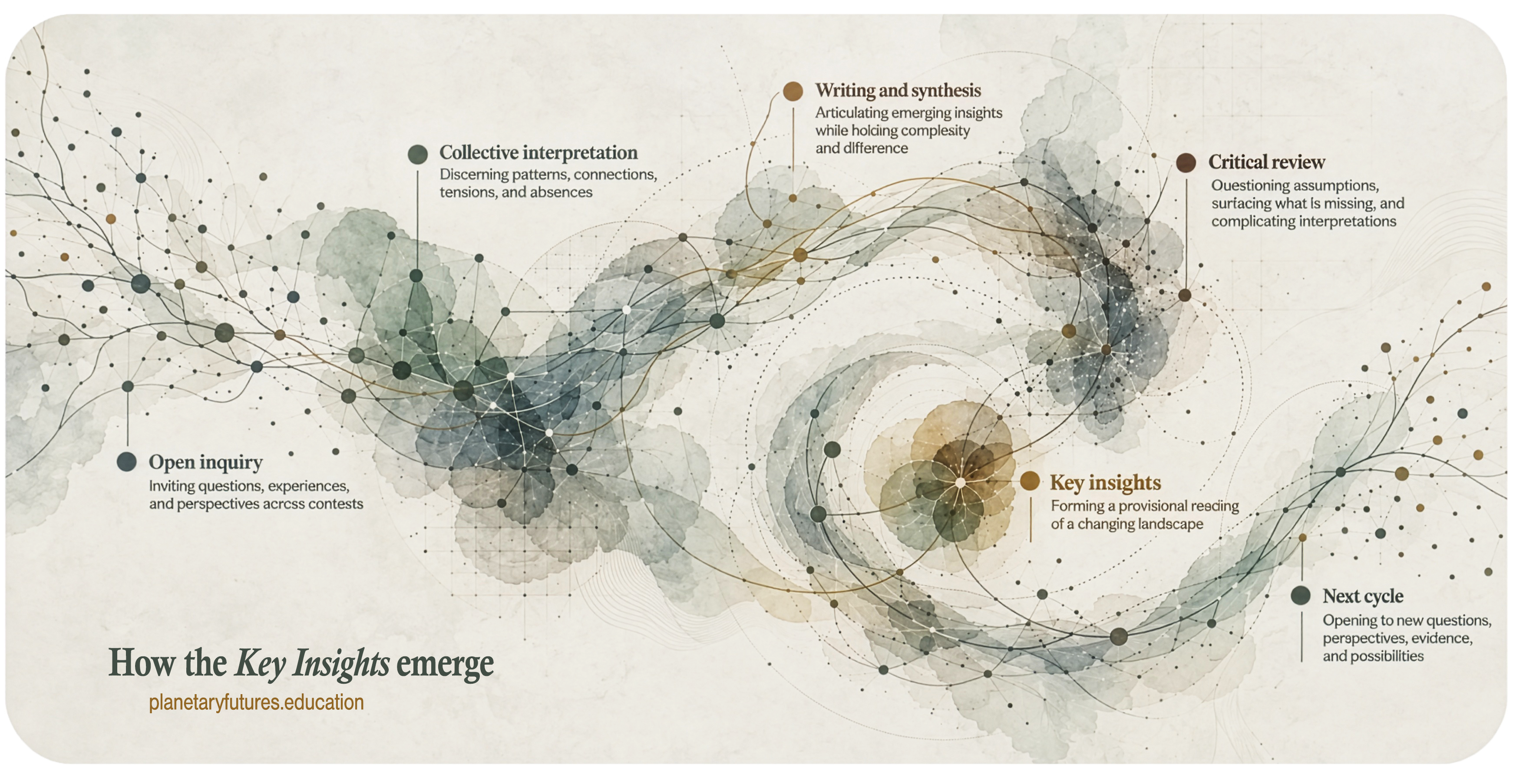
Key Insights is grounded in the premise that no single discipline, institution, region, or knowledge tradition can fully understand the educational transformations shaping planetary futures. The challenges facing education unfold across ecological, social, cultural, technological, and political systems. Understanding them requires an equally interconnected process of inquiry—one capable of bringing different forms of knowledge and experience into relationship across disciplinary, geographic, institutional, and epistemic boundaries.
The initiative grew out of the Global Futures-Oriented Research Collective on Education for Sustainability (G-FORCES), a U.S. National Science Foundation (NSF)–supported AccelNet program led by Iveta Silova, Gustavo Fischman, and Andrea Weinberg at Arizona State University. G-FORCES was designed to create a network of networks for strengthening international collaboration across education and planetary sustainability. Key Insights extends this model through a distributed collaboration anchored at Arizona State University through the Education for Planetary Futures Research Collaborative at Mary Lou Fulton College for Teaching and Learning Innovation and the Julie Ann Wrigley Global Futures Laboratory. It works in collaboration with the UNESCO-MOST BRIDGES Coalition and partners across academic, policy, and practice settings. Together, these relationships provide the organizational foundation for recurring cycles of collaborative inquiry, synthesis, and engagement across regions and knowledge traditions.
The ten insights took shape through a multi-stage process of open inquiry and collective sensemaking, inspired in part by the 10 New Insights in Climate Science (Future Earth et al., 2025). An open global survey invited researchers, educators, policymakers, practitioners, and others working across education and planetary futures to identify consequential shifts, questions, and developments. The survey generated 94 submissions from participants representing diverse geographic, institutional, and professional settings. These contributions were then brought into dialogue with relevant research and practice to identify wider patterns, connections, tensions, and absences among perspectives and contexts.
From this wider landscape, the editorial team worked collectively to interpret and prioritize the insights that anchor this report. Prioritization unfolded through dialogue, with attention to the significance of proposed developments, the connections they revealed across submissions and fields, their grounding in relevant scholarship and practice, and their potential to bring overlooked questions and possibilities into view. Interdisciplinary writing teams then developed each insight by bringing scholarship, practice, and situated knowledge into conversation. Illustrative cases were identified through this collaborative process for their ability to ground the pathways in particular places and practices, and were revisited through successive rounds of review to deepen contextual understanding and strengthen the care and accuracy with which they were represented. Dialogue within writing teams, across the wider network, and with external reviewers expanded the knowledge base, brought overlooked perspectives into view, and continued to reshape the insights. Differences were treated as generative openings for questioning assumptions, complicating interpretations, and deepening collective understanding.
The process is guided by four core commitments:
- Epistemic openness—engaging multiple ways of knowing while maintaining analytical rigor.
- Contextual and cultural diversity—bringing different places, experiences, and educational realities into conversation.
- Methodological reflexivity—critically examining the assumptions, perspectives, and frameworks that shape what becomes visible, consequential, or overlooked.
- Relevance to policy and practice—connecting collective inquiry with the decisions, practices, and conditions shaping education.
The resulting ten insights are neither exhaustive nor ranked; they reflect some of the consequential patterns that became visible through this cycle of inquiry. Future cycles will revisit and extend this reading as participation, evidence, and planetary conditions change. This process is necessarily partial. No cycle of inquiry can encompass the full range of educational knowledge, experience, and practice across regions and traditions, and what becomes visible is shaped by who participates, which evidence is available, and the conceptual and methodological lenses brought to the inquiry. Gaps and absences identified through review become questions for subsequent cycles of inquiry.
References
Bateson, G. (1972). Steps to an ecology of mind: Collected essays in anthropology, psychiatry, evolution, and epistemology. Chandler Publishing Company.
Future Earth, The Earth League, & World Climate Research Programme. (2025). 10 new insights in climate science 2025/2026. https://doi.org/10.5281/zenodo.17328963
Sterling, S. (2001). Sustainable education: Re-visioning learning and change. Green Books.
Sterling, S. (2004). Higher education, sustainability, and the role of systemic learning. In P. B. Corcoran & A. E. J. Wals (Eds.), Higher education and the challenge of sustainability (pp. 49–70). Kluwer Academic Publishers. https://doi.org/10.1007/0-306-48515-X_5
UNESCO. (2020). Education for sustainable development: A roadmap. https://doi.org/10.54675/YFRE1448
UNESCO. (2023). Recommendation on education for peace and human rights, international understanding, cooperation, fundamental freedoms, global citizenship and sustainable development. https://www.unesco.org/en/legal-affairs/recommendation-education-peace-and-human-rights-international-understanding-cooperation-fundamental
United Nations. (n.d.). Goal 4: Ensure inclusive and equitable quality education and promote lifelong learning opportunities for all. Retrieved September 2, 2026, from https://sdgs.un.org/goals/goal4
Suggested citation
Silova, I., Fischman, G., & Weinberg, A. (2026). Education for planetary futures: Learning with a changing world. In I. Silova, G. Fischman, V. Desimoni, S. Hartman, A. Weinberg, D. Anayatova, S. F. Beardmore, R. Iyengar, C. Karsgaard, K. Keena, H. Komatsu, C. Kwauk, G. M. L. Mendes, T. McCowan, D. L. Morrison, A.-L. Neurohr, & J. Rappleye (Eds.), Key insights on education for planetary futures. Education for Planetary Futures Collaborative, Julie Ann Wrigley Global Futures Laboratory, UNESCO-MOST BRIDGES. https://doi.org/10.14507/lfc-epf-keyinsights.intro